Posted: December 29th, 2012 | Filed under: drugs, heroin, LSD, marijuana, opiates, prostitution, You Will Die | 2 Comments »

In coordination with the January 1st release of the Feral House version of You Will Die: The Burden of Modern Taboos, AlterNet published my article, “Ten Ways Social Taboos About Sex, Drugs and Death Scare Us from Learning the Truth.”
The ten harmful misconceptions caused by taboos covered in the article are:
1. Taboo: Drugs—Misconception: Jesus was against drug use.
2. Taboo: Sex—Misconception: Few women choose to be sex workers.
3. Taboo: Drugs—Misconception: Drugs do not aid creativity.
4. Taboo: Excrement—Misconception: We go to the bathroom properly.
5. Taboo: Drugs—Misconception: Illicit drugs are exceptionally deadly.
6. Taboo: Sex—Misconception: Jesus was against non-marital sex.
7. Taboo: Nasal Mucus—Misconception: Nose-picking is bizarre.
8. Taboo: Sex—Misconception: Homosexuality is a choice.
9. Taboo: Drugs—Misconception: Drug dealers cause drug use.
10. Taboo: Death—Misconception: Modern medicine can save us.
Thanks to Kristen Gwynne (@kristengwynne) at AlterNet for running this unconventional piece.
Posted: May 18th, 2012 | Filed under: drugs, media bias, opiates | 1 Comment »
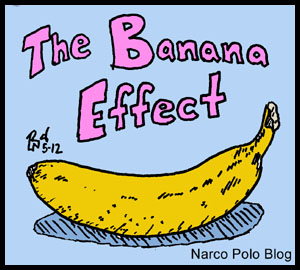
Yesterday, the White House drug czar, R. Gil Kerlikowske, wrote an article that implies drugs cause crime. He based this on the fact that more than half of adult male arrestees test positive for at least one drug. This does not mean that drugs cause crime.* It means that drug use, like tattoos, correlates with criminal behavior. One of the reasons for this correlation is that criminalization and media propaganda can statistically link anything with crime – even bananas.
This Banana Effect can be demonstrated by a hypothetical scenario. In an imaginary United States bananas are made illegal and every media source begins spouting that eating bananas is irresponsible, dangerous, and horrible for one’s health. Responsible, law-abiding, health-conscious citizens would stop eating bananas. Surveys of banana eaters would start to show that they commit more crimes and are unhealthier than non-banana eaters. Bananas did not change. The population using them changed.
This is exactly what happened when drugs were criminalized at the beginning of the 20th century. An opiate authority at the time was Dr. Charles Terry. He wrote, “… a very large proportion of the users of opiate drugs were respectable hardworking individuals in all walks of life, and … only about 18% could in any way be considered as belonging to the underworld.” (1)
Numerous studies have discovered that drug-using criminals are usually criminals before their drug use begins. One study found that a heroin user’s first arrest typically occurs 18 months before heroin use starts. (3) The exorbitant costs of drugs caused by criminalization undoubtedly drive some addicts to crime, however, most addict-criminals were criminals first. The drugs and crime nexus is driven more by the population using the drugs than by the drugs themselves.
* Kerlikowske knew he did not have evidence of causation which is why he used the weasel word “link” instead of “cause.”
Note: I am presenting the Banana Effect in the next edition of You Will Die: The Burden of Modern Taboos, and assume that I am not the first person to have recognized it. If you know of someone who has already coined a term for self-selection bias due to the influence of the media and/or criminalization please contact me so that I can give proper credit.
Sources
1. Opiates include drugs like morphine and heroin. Mike Gray, Drug Crazy: How We Got into This Mess and How We Can Get Out (1998), p. 53.
2. R. Gil Kerlikowske, “Study: More Than Half of Adult Male Arrestees Test Positive for at Least One Drug,” HuffingtonPost.com, 17 May 2012. LINK
3. Richard Miller, Case for Legalizing Drugs (1991), pp. 60, 189.
Posted: May 10th, 2012 | Filed under: drugs, hallucinogens, marijuana, opiates | 13 Comments »
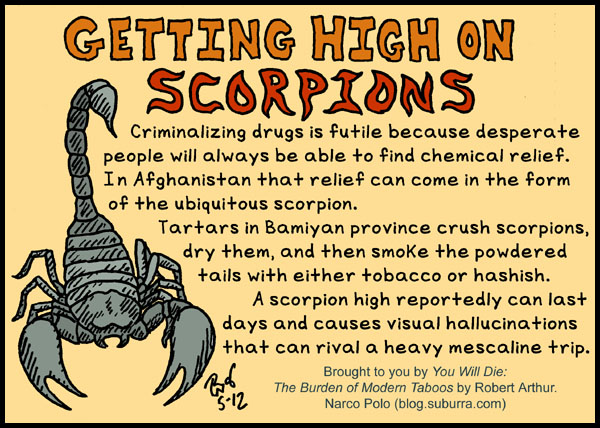
David Macdonald argues in his 2007 book, Drugs in Afghanistan, that Afghanistan’s increased drug usage is driven by an impoverished battle-scarred population trying desperately to relieve its suffering.* Western-led efforts to universally criminalize drugs are futile because distressed people will always be able to find chemical relief.
As an example, Macdonald notes that in Afghanistan even the ubiquitous scorpions can be used for intoxication. Tartars in Bamiyan province prepare scorpions by smashing them between stones and letting them dry. The main part of the tail, with the sting, is then crushed into a powder and smoked with tobacco and/or hashish (marijuana).
A friend of Macdonald’s who witnessed a man smoke scorpion in the Afghan town of Peshawar described the reaction:
The effect was instantaneous with the man’s face and eyes becoming very red, “much more than a hashish smoker” …. He also seemed very intoxicated but awake and alert, although he stumbled and fell over when he tried to rise from a sitting position …. the smoke tasted “sweeter” than that of hashish, although … it smelled foul, and the intoxicating effect lasted much longer. (1, p. 247)
As with most drugs, anecdotal reports of scorpion’s effects vary widely. It is likely that the numerous Afghan scorpion species have divergent psychoactive properties. Scorpion has been reported to keep one awake, cause severe headaches, and rival the effects of a “strong mescaline trip.” (1, p. 248) One Kabul man who had smoked between 20 and 30 times reported the effects to last three days. During these periods he had difficulty opening his eyes, his head spun, and he had constant visual hallucinations.
Globally, scorpion smoking is still rare. The failure of the war on other drugs has not driven people to seek it out … yet. If drug war success sparking scorpion use sounds unbelievable, in India’s Western states police crackdowns on mainstream illicit drugs have already led to “sting sellers.” A police officer in the city of Bharuch said:
Because of our successful drives against the sellers and addicts of alcohol, opium, cough syrup, and heroin in urban areas, young people are flocking on the highways to try the new craze of scorpion stings. (2)
The futility of drug criminalization may become comically clear if more drug war “victories” bring about a war on arachnids.
* Macdonald is a sociologist who has specialized in drug control for over 20 years. From 1999 until his book’s publication in 2007 he served as the demand reduction adviser for the UN drugs control program in Afghanistan with UNODC and also with the Ministry of Counter Narcotics in Kabul.
Sources
1. David Macdonald, Drugs in Afghanistan: Opium, Outlaws, and Scorpion Tales (2007). LINK
2. “New Drugs Craze Has a Scorpion Sting in the Tail,” Scotsman.com, 25 Apr. 2004. LINK