Posted: June 13th, 2013 | Filed under: civil liberties, cocaine, drugs, history, marijuana, prostitution | 2 Comments »

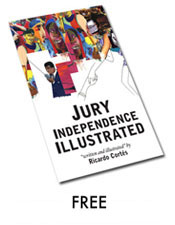
An American juror has the power to deem a defendant “not guilty” in a criminal trial even when the evidence of guilt is overwhelming. The juror can, in effect, nullify a law believed to be either unjust or unjustly applied. This legal doctrine is known as jury nullification. Drug-war opponents and sex-work activists should familiarize themselves with this aspect of jurisprudence, and thanks to Ricardo Cortés jury nullification is now colorfully accessible.
Cortés is the illustrator of the New York Times bestselling children’s book, Go the F*ck to Sleep (2011).* He also wrote and illustrated the children’s book about marijuana, It’s Just a Plant (2005), and A Secret History of Coffee, Coca & Cola (2012). His illustrated book on jury nullification is called Jury Independence Illustrated (2011) and the ebook can be viewed for free here.
Jury nullification has a rich history dating back to before the Revolutionary War. In colonial times it was used to free people prosecuted for criticizing the government. During the 19th century, juries as far south as Georgia would refuse to convict people who aided escaped slaves. During the 20th century, juries used it to free alcohol criminals under prohibition, artists charged under obscenity laws, and homosexuals charged under sodomy laws. (Critics point out that racist juries have also used jury nullification to free persecutors of minorities. A recent case where this may have occurred is here.)
Although jury nullification is explicitly authorized in three state constitutions, many jurisdictions bar judges and lawyers from telling jurors about it. California has gone so far as to rule that a juror who openly argues for jury nullification can be discharged. In contrast, the “Live Free or Die” state of New Hampshire made it a state law in 2012 that judges must allow defense attorneys to inform jurors of their authority to nullify. (Read more about California’s ruling here, and New Hampshire’s law here.) Due to jurisdictions like California, the Fully Informed Jury Association (FIJA) advises:
We caution jurors NOT to lobby their fellow jurors obviously toward nullification during deliberations! It has been established in court precedent that judges may remove jurors, even during deliberations, if the judge becomes aware that they are considering jury nullification in coming to a verdict. If a single fully informed juror is removed from the jury because he or she made his or her intentions known by attempting to lobby other jurors, the defendant may be left without anyone in his or her corner during deliberations. It is much better for the defendant if that fully informed juror simply hangs the jury. A hung jury is always better than a conviction, and the prosecutor will have to think twice about whether or not it is even worth it to retry the case. (2)
Prominent advocates of jury nullification for drug cases include the writers of HBO’s Baltimore drama The Wire, San Diego Mayor Bob Filner, and the George Washington Law School professor Paul Butler. Their statements can be read here, here, and here respectively.
For more detailed information on how to ethically get seated on a jury in order to nullify the prosecutions of non-violent drug criminals read “A Guide to Surviving as a Juror” by the Texas attorney, Clay Conrad. Conrad is the author of Jury Nullification: The Evolution of a Doctrine (1999).

* Samuel L. Jackson’s reading of the book went viral in 2011. It can be seen here.
Sources
1. Clay Conrad, “A Guide to Surviving as a Juror,” CounterPunch.com, 5 Feb. 2003. LINK
2. “Reminder: Juries Can Nullify Marijuana Charges If They Find Them Unjust,” FIJA.org, 1 Apr. 2013. LINK
Posted: December 29th, 2012 | Filed under: drugs, heroin, LSD, marijuana, opiates, prostitution, You Will Die | 2 Comments »

In coordination with the January 1st release of the Feral House version of You Will Die: The Burden of Modern Taboos, AlterNet published my article, “Ten Ways Social Taboos About Sex, Drugs and Death Scare Us from Learning the Truth.”
The ten harmful misconceptions caused by taboos covered in the article are:
1. Taboo: Drugs—Misconception: Jesus was against drug use.
2. Taboo: Sex—Misconception: Few women choose to be sex workers.
3. Taboo: Drugs—Misconception: Drugs do not aid creativity.
4. Taboo: Excrement—Misconception: We go to the bathroom properly.
5. Taboo: Drugs—Misconception: Illicit drugs are exceptionally deadly.
6. Taboo: Sex—Misconception: Jesus was against non-marital sex.
7. Taboo: Nasal Mucus—Misconception: Nose-picking is bizarre.
8. Taboo: Sex—Misconception: Homosexuality is a choice.
9. Taboo: Drugs—Misconception: Drug dealers cause drug use.
10. Taboo: Death—Misconception: Modern medicine can save us.
Thanks to Kristen Gwynne (@kristengwynne) at AlterNet for running this unconventional piece.
Posted: October 11th, 2012 | Filed under: civil liberties, drugs, marijuana | Comments Off on How to Write About Your Crimes on the Web
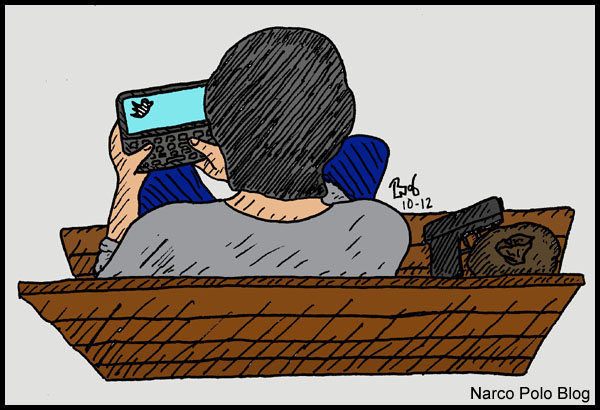
In America, it is not illegal to write about your past crimes, and the following is a guide to doing it online. I am an attorney who has practiced criminal defense law, however, this article merely provides general legal information—not legal advice.
Any defense attorney will tell you that it is almost never prudent to make statements about your past crimes. This is particularly true online as it creates evidence, often permanent, that can be used in your prosecution. Unless you are masking your identity with software like Tor, every web site that you visit can record your computer’s Internet Protocol (IP) address. Without masking, this IP address is also delivered with every e-mail you send.
Nevertheless, even if the only precaution you take is to use a pseudonym it is highly unlikely you will be tracked down by law enforcement if you do it in a global forum and only talk about low-level crimes like sex work or drug use. It is not because the authorities cannot find you, but because it is not worth their time. Even the simple act of filing a warrant to discover an IP address is usually not worthwhile for multiple reasons:
- They do not know if you are lying.
- They would have to prove that it was you that used your computer and your pseudonym.
- They would have to have some evidence in addition to the internet admission.
- They often do not know if the crime occurred in their jurisdiction.
- They often do not know if the crime occurred outside of the statute of limitations.
There are three things you can do to increase the odds you will not be pursued. The most obvious is to hide your identity and any clues to your identity. Talking about a crime on a social network like Facebook, even with an alias, is risky as profiles provide other identifying information.
In forums that discuss drug use the acronym SWIM is often used instead of “I.” SWIM stands for “someone who isn’t me.” Using SWIM is better than using a first-person narrative but more creative obfuscation would be better. For example, saying a friend did the described activity.
Second, do not reveal the location of the crime. Law enforcement is bound by its jurisdiction. Police are significantly less likely to pursue a low-level crime if they are unsure if it occurred in their jurisdiction. For example, Philadelphia police are not going to waste time investigating something that probably occurred in another municipality or another state. For this reason, writing about crimes in a local forum, like the Littlestown Crocheting Message Board, is not wise.
Federal authorities have broader jurisdiction but rarely pursue low-level crimes, and they would almost never waste resources investigating a low-level crime that may have occurred abroad.
Third, do not disclose when the crime happened. Most crimes have a time limit on how long they are allowed to be prosecuted. These limits are called statutes of limitations. Law enforcement is unlikely to investigate low-level crimes that may no longer be open to prosecution.
Writing about your crimes online is rarely advisable, however, writing about low-level crimes in global forums has scant chance of spurring investigation if you use these precautions.
Links
- Criminal statute of limitations laws by state: LINK
- Facebook’s procedures for law enforcement seeking a user’s data: LINK
- Rocco Parscandola, “NYPD Forms New Social Media Unit to Mine Facebook and Twitter for Mayhem,” NYDailyNews.com, 10 Aug. 2011. LINK
- Tor’s website: LINK
Bonus
The following tweets by Mary Wanna? are examples of oversharing online. Follow Marry Wanna? on Twitter at @the_high_life.