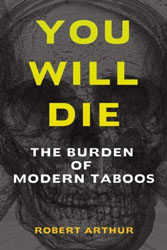
Posted: April 24th, 2008 | Filed under: You Will Die | Comments Off on A Brave Best-Selling Writer Gets Me, He Really Gets Me
 In the late 1950s and early 1960s when both sex and race were fiercely off-limits Robert Gover courageously breached both topics. He wrote a novel, One Hundred Dollar Misunderstanding (1962), about a black prostitute and a rich white college boy. It was initially rejected by American publishers. Only after being successfully issued in Europe was it published in the States. The book then climbed to third on the New York Times best-seller list even though the newspaper refused to accept advertisements for it due to its controversial nature.
Gover’s work has not only enjoyed commercial success, but it has also earned the praise of such luminaries as Gore Vidale, Joseph Heller, and Bob Dylan. Another legend, Gover’s friend, Jim Morrison, wanted to direct and star in a movie adaption of Gover’s book, The Maniac Responsible (1963). Now in his late seventies Gover continues to eschew the commercial, the popular, and the mainstream by maintaining his own nuts-and-bolts website and writing about astrology.
I knew nothing about this man until he contacted me and offered to write a review of my book, You Will Die: The Burden of Modern Taboos. His wonderful review has recently been published in the literary magazine, Perigee. Although Gover writes that, “no major American publisher would touch [You Will Die] with a ten-foot pole,” he adds that, “given a decent promotional campaign, this book has what it takes to top the New York Times bestseller list for months.”
In favorably comparing my book to the amazing Alan Watts book, The Book: On the Taboo Against Knowing Who You Are (1966), Gover writes:
The main difference between the approaches of Watts and Arthur is that Watts aims at self-enlightenment while Arthur aims at societal enlightenment. This difference reflects the different tempers of these different times, the 1960s and the first decade of the 21st Century.
I am honored.
Sources
- Robert Gover, “On The Way to a Fortunate Misunderstanding,” 2005. LINK
- Robert Gover, “You Will Die: The Burden of Modern Taboos [review],” Perigee, Apr.-Jul. 2008. LINK
- Thomas Kennedy, “A Conversation with Robert Gover,” Perigee, Aug.-Oct. 2007. LINK
Posted: April 23rd, 2008 | Filed under: drugs, heroin, legalization, opiates | 59 Comments »
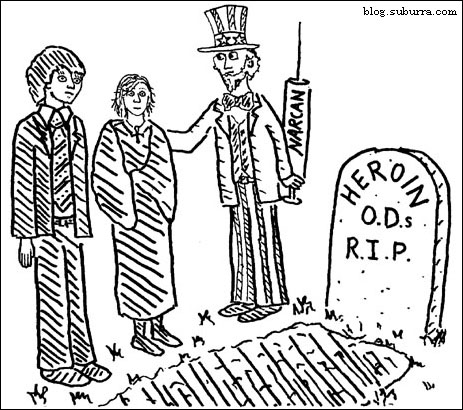
Heroin Kills?
To get people to read my book I employ the common technique of teasers. Teasers for non-fiction books are often facts that will startle the reader and encourage them to find out more. None of my teasers have provoked greater skepticism, scorn, and anger than the statement, “Heroin is harmless.”
I am not naive or callous. As a public defender I frequently interviewed heroin addicts upon their incarceration. I saw firsthand these people going through withdrawal and I saw the tragedies their lives had become. However, almost all – if not all – of the damage heroin had inflicted upon these people and their families was due to the drug’s criminalization. I will explain.
Three aspects of an ingestible substance that can be considered harmful are (1) its potential to debilitate, (2) its effects on one’s health, and (3) its potential to kill via an overdose.
(1) Like the stimulants, caffeine and cocaine, heroin is not a debilitating drug. That is, moderate usage does not interfere with one’s functioning, e.g. driving ability. This is in contrast to alcohol, in which one’s performance is directly hampered. Extreme usage can interfere just like with caffeine and cocaine, e.g. too much of a stimulant can make it difficult to focus and even cause hallucinations. However, even heroin addicts can moderate their usage so that they can work unimpaired and avoid withdrawal symptoms. For this reason, heroin addicts can and do have successful professional lives in such diverse fields as surgery and law enforcement.
(2) Long-term heroin addiction is relatively harmless to one’s health. Like caffeine addicts who “need” their coffee in the morning, the side-effects are minimal. Heroin’s long-term side-effects can include constipation and impotency. This is in contrast to alcohol and tobacco which destroy the liver and the lungs respectively.
(3) Like caffeine, it is difficult to fatally overdose on heroin by itself. (It is easy to overdose when using heroin and alcohol in combination.) The popular image of a dead heroin user with the needle still in his or her arm is misleading. A fatal heroin overdose is usually a long process that takes over an hour and it can be countered within minutes by an antidote.
This antidote is Narcan. It is so tightly regulated that strict limits on its usage have caused overdose deaths even when paramedics were present. Narcan is not dangerous or addictive which leads one to believe the government wants heroin users to die. This twisted thesis is reinforced by recent comments made in light of nasally administered Narcan (LINK).
Lastly, heroin withdrawal – unlike alcohol withdrawal – is never fatal.
In many ways heroin is as harmless as caffeine and it is definitely less harmful than alcohol. Heroin has garnered the reputation of the deadliest and most evil of drugs largely due to side-effects from the War on Drugs. To learn the awesome and fascinating reality of it all, read my book, You Will Die: The Burden of Modern Taboos. For more on the safe usage of heroin devoid of moralizing read Dr. Francis Moraes’ Heroin User’s Handbook. (Moraes is a former heroin addict.)
Sources
- Robert Arthur, You Will Die: The Burden of Modern Taboos (2007). LINK