Posted: June 20th, 2013 | Filed under: civil liberties, terrorism | 1 Comment »
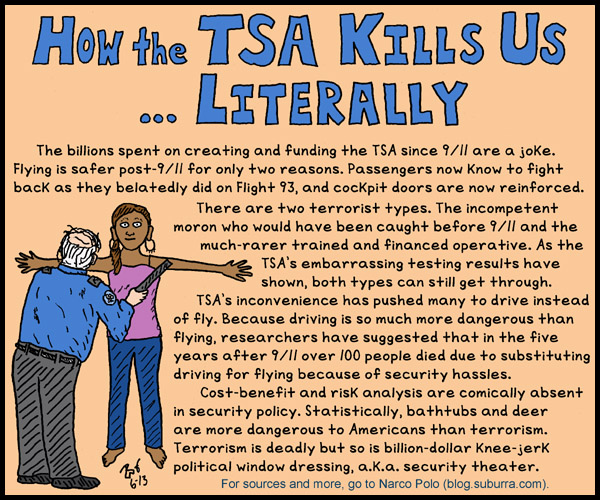
Cartoon Text
The billions spent on creating and funding the TSA since 9/11 are a joke. Flying is safer post-9/11 for only two reasons. Passengers now know to fight back as they belatedly did on Flight 93, and cockpit doors are now reinforced. (5)
There are two terrorist types. The incompetent moron who would have been caught before 9/11 and the much-rarer trained and financed operative. As the TSA’s embarrassing testing results have shown, both types can still get through. (6)
TSA’s inconvenience has pushed many to drive instead of fly. Because driving is so much more dangerous than flying, researchers have suggested that in the five years after 9/11 over 100 people died due to substituting driving for flying because of security hassles. (2, 1)
Cost-benefit and risk analysis are comically absent in security policy. (4) Statistically, bathtubs and deer are more dangerous to Americans than terrorism. (3) Terrorism is deadly but so is billion-dollar knee-jerk political window dressing, a.k.a. security theater.
Bonus
For more TSA absurdity go to the blog, Taking Sense Away. It is written by a humorous former TSA employee. Learn about passengers “spooging” screeners and screeners retaliating by “splitting the uprights” in this post.
A clever infographic on a potpourri of abysmal TSA numbers is “TSA: Grope and Pillage.”
An excellent short article from 2011 on terrorism risk is “How Scared of Terrorism Should You Be?” by Ronald Bailey at Reason.com.
Disclaimer
Hours after drawing the above cartoon I saw that the daughter of my contact at Boing Boing, Mark Frauenfelder, recently had a regrettable experience with TSA. (This can be read about here.) This cartoon should not be interpreted as a juvenile attempt at retaliation. I have no reason to doubt that the vast majority of TSA workers are decent individuals who are trying to make flying safer. My criticism is focused on the politicians and bureaucrats who, in the words of Bill Clinton’s counterterrorism coordinator Richard Clarke, do not have the political courage to avoid “procedures that inconvenience the public more than they do the terrorists.” (4)
Sources
1. Garrick Blalock, Vrinda Kadiyali, and Daniel Simon, “The Impact of 9/11 on Road Fatalities: The Other Lives Lost to Terrorism,” Applied Economics, 2009, 41(14). LINK
2. Charles Kenny, “Airport Security is Killing Us,” BusinessWeek.com, 18 Nov. 2012. LINK
3. John Mueller and Mark Stewart, “Hardly Existential: Thinking Rationally about Terrorism,” ForeignAffairs.com, 2 Apr. 2010. LINK
4. John Mueller and Mark Stewart, “Terror, Security, and Money: Balancing the Risks, Benefits, and Costs of Homeland Security,” 1 Apr. 2011. LINK (PDF)
5. Bruce Schneier, “Economist Debates: Airport Security,” Economist.com, 20 Mar. 2012. LINK
6. “TSA Misses Guns, Bombs in Tests,” JudicialWatch.org, 20 Dec. 2010. LINK
Posted: June 13th, 2013 | Filed under: civil liberties, cocaine, drugs, history, marijuana, prostitution | 2 Comments »
An American juror has the power to deem a defendant “not guilty” in a criminal trial even when the evidence of guilt is overwhelming. The juror can, in effect, nullify a law believed to be either unjust or unjustly applied. This legal doctrine is known as jury nullification. Drug-war opponents and sex-work activists should familiarize themselves with this aspect of jurisprudence, and thanks to Ricardo Cortés jury nullification is now colorfully accessible.
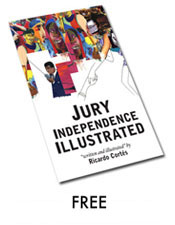
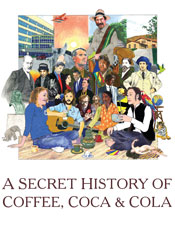
Cortés is the illustrator of the New York Times bestselling children’s book, Go the F*ck to Sleep (2011).* He also wrote and illustrated the children’s book about marijuana, It’s Just a Plant (2005), and A Secret History of Coffee, Coca & Cola (2012). His illustrated book on jury nullification is called Jury Independence Illustrated (2011) and the ebook can be viewed for free here.
Jury nullification has a rich history dating back to before the Revolutionary War. In colonial times it was used to free people prosecuted for criticizing the government. During the 19th century, juries as far south as Georgia would refuse to convict people who aided escaped slaves. During the 20th century, juries used it to free alcohol criminals under prohibition, artists charged under obscenity laws, and homosexuals charged under sodomy laws. (Critics point out that racist juries have also used jury nullification to free persecutors of minorities. A recent case where this may have occurred is here.)
Although jury nullification is explicitly authorized in three state constitutions, many jurisdictions bar judges and lawyers from telling jurors about it. California has gone so far as to rule that a juror who openly argues for jury nullification can be discharged. In contrast, the “Live Free or Die” state of New Hampshire made it a state law in 2012 that judges must allow defense attorneys to inform jurors of their authority to nullify. (Read more about California’s ruling here, and New Hampshire’s law here.) Due to jurisdictions like California, the Fully Informed Jury Association (FIJA) advises:
We caution jurors NOT to lobby their fellow jurors obviously toward nullification during deliberations! It has been established in court precedent that judges may remove jurors, even during deliberations, if the judge becomes aware that they are considering jury nullification in coming to a verdict. If a single fully informed juror is removed from the jury because he or she made his or her intentions known by attempting to lobby other jurors, the defendant may be left without anyone in his or her corner during deliberations. It is much better for the defendant if that fully informed juror simply hangs the jury. A hung jury is always better than a conviction, and the prosecutor will have to think twice about whether or not it is even worth it to retry the case. (2)
Prominent advocates of jury nullification for drug cases include the writers of HBO’s Baltimore drama The Wire, San Diego Mayor Bob Filner, and the George Washington Law School professor Paul Butler. Their statements can be read here, here, and here respectively.
For more detailed information on how to ethically get seated on a jury in order to nullify the prosecutions of non-violent drug criminals read “A Guide to Surviving as a Juror” by the Texas attorney, Clay Conrad. Conrad is the author of Jury Nullification: The Evolution of a Doctrine (1999).

* Samuel L. Jackson’s reading of the book went viral in 2011. It can be seen here.
Sources
1. Clay Conrad, “A Guide to Surviving as a Juror,” CounterPunch.com, 5 Feb. 2003. LINK
2. “Reminder: Juries Can Nullify Marijuana Charges If They Find Them Unjust,” FIJA.org, 1 Apr. 2013. LINK
Posted: May 23rd, 2013 | Filed under: civil liberties, media bias | 2 Comments »
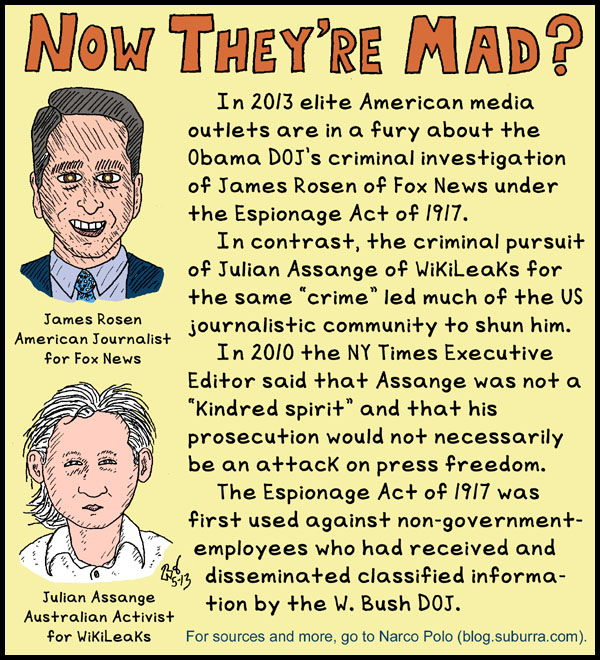
*** Outside of the sources, text below is same as in cartoon. ***
In 2013 elite American media outlets are in a fury about the Obama DOJ’s criminal investigation of James Rosen of Fox News under the Espionage Act of 1917. (3)
In contrast, the criminal pursuit of Julian Assange of WikiLeaks for the same “crime” led much of the US journalistic community to shun him. (4, 3)
In 2010 the NY Times Executive Editor said that Assange was not a “kindred spirit” and that his prosecution would not necessarily be an attack on press freedom. (1)
The Espionage Act of 1917 was first used against non-government-employees who had received and disseminated classified information by the W. Bush DOJ. (2)
Sources
1. Jeff Bercovici, “NY Times Editor: WikiLeaks Is ‘Not My Kind of News Organization,'” Forbes.com, 16 Dec. 2010. LINK
2. Glenn Greenwald, “Attempts to Prosecute WikiLeaks Endanger Press Freedoms,” Salon.com, 14 Dec. 2010. LINK
3. Rebecca Shapiro and Jack Mirkinson, “Obama Administration’s Media Surveillance Unleashes Wave of Condemnation,” HuffingtonPost.com, 22 May 2013. LINK
4. Nancy Youssef, “In WikiLeaks Fight, US Journalists Take a Pass,” McClatchyDC.com, 9 Jan. 2011. LINK